CS2 Spray Patterns & Recoil Control
How spray patterns work in CS2, why sub-tick changes the feel from CS:GO, and a 30-minute weekly drill to make recoil control stick.
Most players in the lower CS Rating brackets (the Gray and Light Blue Premier tiers, roughly 1,000 to 10,000) know spray control exists. They know to “pull down.” They still lose gunfights at 15 meters because knowing the concept and owning the muscle memory are different things, and because CS2’s recoil feel differs enough from CS:GO that returning players fight years of wrong habits while they relearn.
This guide covers how the patterns work mechanically, what changed in CS2, and how to build reliable spray control in the shortest training time.
What Is a Spray Pattern? (CS2 vs CS:GO)
Every automatic weapon in CS2 fires bullets in a fixed sequence. Hold mouse1 without moving your mouse and bullets 1 through 30 land in the same positions every time. That fixed sequence is the spray pattern.
Counter-Strike has always worked this way. The difference is that in CS2, rendered viewangle adjustments from recoil update per frame, not per tick. In CS:GO at 64 tick, the camera snapped in discrete steps 64 times per second. In CS2 the camera moves every rendered frame, so at 300 fps it updates roughly 5x more often than 64-tick CS:GO did. The bullet trajectories are similar, but what you see the gun do is smoother.
This is why returning players describe CS2 spray as “slippery” or “harder to feel.” Your CS:GO muscle memory was calibrated to discrete camera snaps. CS2’s per-frame rendering removes those snaps. The pattern itself has not changed dramatically, but the feedback loop your hands trained on has.
How Sub-Tick Changes the Feel of Recoil
CS2’s sub-tick system timestamps every input (keypress, release, mouse movement) within a server tick. The server reconstructs when you started counter-strafing, not just “during tick 847.”
For recoil, the practical consequence is that your mouse input registers more precisely relative to bullet timing. In CS:GO, a correction made 5ms into a tick applied at the start of the next tick, up to roughly 15ms later at 64 tick. In CS2, sub-tick uses the actual timestamp, so your spray corrections land closer to when you made them.
The September 19, 2025 patch fixed a regression where view punch (the visual camera kick from recoil and from taking damage) was calculated incorrectly, breaking spray consistency for some weapons. If you read a pre-September-2025 spray guide and the patterns feel off, that fix is likely why. The patterns have settled back to their original form since.
Any recoil changes shipped between the September 2025 patch and June 2026 should be verified against Valve’s CS2 patch notes, since multiple weapon balance passes happen per year. The most consequential recent change is the March 18, 2026 reload update, which overhauled magazine and reserve ammo (reloading now discards the partial magazine instead of topping it off). That change does not alter spray patterns themselves; it changes how much you can spray before running dry.
Counter-Strafing Before the Spray: Why Order Matters
You cannot spray accurately while moving. Full stop. Counter-strafing is the prerequisite, not an advanced technique to bolt on later.
Why the timing is tight: releasing your movement key brings velocity toward zero gradually. Counter-pressing the opposite direction (tapping A while holding D, or the reverse) cancels momentum and drops velocity below the accuracy threshold far faster. Counter-strafing is the entry condition for reliable spray accuracy, not an optional refinement.
The order is:
- Counter-strafe (tap the opposite key)
- Wait for the brief accuracy window as velocity drops
- Begin firing
Spraying before you have stopped turns the pattern into noise. Every drill in this guide assumes you are stationary when the spray starts.
AK-47 Spray Pattern and Pull Guide
The AK-47 is the T-side rifle and the weapon most spray guides start with, because its pattern has high mechanical variance and the most noticeable visual kick. It deals 36 base damage with 77.5% armor penetration and fires at 600 RPM.
Pull shape (community consensus):
- The opening of the magazine pulls almost straight down with moderate vertical speed
- The middle of the magazine sweeps sideways: first a leftward correction, then a rightward one, as the pattern drifts
- The tail of the magazine is chaotic; consistent hits here require burst discipline, not full spray
Learn the exact per-bullet directions from the in-game Recoil Master overlay or a current spray visualizer rather than from memorized numbers, since the pattern is something you feel more than count.
The early bullets are the highest-value zone. Most realistic engagements end inside the first third of the magazine, and that cluster is tight enough to land headshots at medium range if you hit the pull correctly.
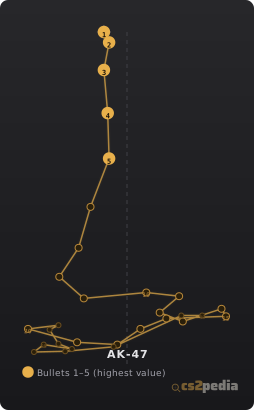
An AK headshot kills a full-HP target instantly regardless of armor. The incentive to land bullets 1 to 5 in the head is higher than with the CT rifles.
M4A4 Spray Pattern and Pull Guide
The M4A4 deals 33 base damage to the AK’s 36, but it fires faster at 666 RPM with a 30-round magazine. Spray control stays active throughout; there is no cruise zone where you stop correcting.
Pull shape (community consensus):
- The opening of the magazine pulls slightly down and stays mostly vertical
- The middle and tail drift sideways and demand continuous correction; there is no cruise zone where you can stop adjusting
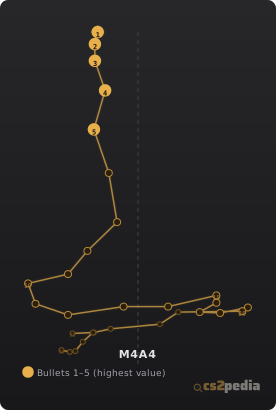
The M4A4 demands continuous wrist engagement across the whole magazine more than the AK does. Players who learn the AK first sometimes find the M4A4 harder, because the AK has a cleaner vertical phase to ingrain first. As with the AK, read the exact mid-spray directions off the Recoil Master overlay; the sideways correction is something you train by sight, not by counting bullets.
M4A1-S Spray Pattern and Pull Guide
The M4A1-S fires slower (600 RPM vs 666 RPM for the M4A4), carries 20 rounds instead of 30, and produces lower recoil than the M4A4. The lower fire rate gives you slightly more time between bullets to adjust, which makes it more forgiving while you are still building spray muscle memory.
Pull shape (community consensus):
- The opening of the magazine pulls down
- The middle sweeps sideways, left then right, the same way the AK does but with gentler kick
- The tail zig-zags; full-magazine sprays past this point are low-percentage
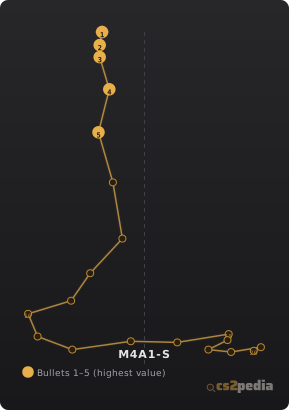
The silencer means no muzzle flash obscuring your crosshair. That is a genuine mechanical advantage for spray tracking; you can see where your shots are going throughout the magazine.
Trade-off vs the M4A4: 10 fewer rounds, and a one-shot headshot still requires removing the helmet first (same as the M4A4, neither one-taps helmeted heads).
SG 553 Spray Pattern and Pull Guide
The SG 553 is the T-side scoped rifle at $3,000. Most spray guides ignore it, which is why it stays underused in the bracket this guide targets. Its 100% armor penetration is the highest of any assault rifle, higher than the AK’s, and its scope (a 3x ACOG) gives an accuracy boost the AK does not have.
Pull shape (community consensus, unscoped):
- The opening of the magazine kicks on a strong down-left angle; the vertical kick is similar to the AK in magnitude but the left bias is more pronounced from the start
- After the initial kick there is a brief stable zone where the pattern needs minimal adjustment
- The back half drifts right, so you pull right to compensate
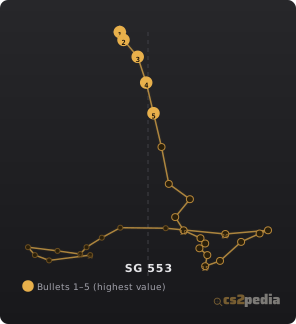
The SG 553’s first-shot accuracy and full armor penetration make it competitive at ranges where the AK would demand a tap. If you are comfortable with the pull sequence, it is a meaningful upgrade for $300 over the AK.
AWP: Why Spray Patterns Don’t Apply (and What Does)
The AWP has no meaningful spray pattern for practical purposes. Its fire rate is too slow and recoil between shots too severe for any multi-bullet correction to apply. What matters instead:
AWP accuracy mechanics:
- Full accuracy when scoped and fully stationary
- Accuracy degrades the moment you move, even at walking speed
- The AWP deals 115 base damage with 97.5% armor penetration; it one-shots to the chest and head at any range, but does not one-shot to the legs
- Counter-strafing applies: be stationary before scoping for the full accuracy bonus
What to practice instead of spray:
- Scope draw speed and the timing between scoping and firing (there is a short delay before full accuracy returns after scoping, so don’t fire the instant the scope appears)
- One-tap timing: fire, scope out, counter-strafe, re-scope
- Peek discipline: the AWP punishes wide peeks harder than it punishes any spray weapon
Burst Firing vs Full Spray: When to Use Each
Full spray is one tool. Knowing when not to use it matters just as much.
Use full spray when:
- Target is within 10 to 15 meters (AK / M4A4 / M4A1-S reliable range)
- You are already stopped with a clean line
- Target is stationary or slow-moving
Use burst (2 to 5 bullets) when:
- Target is 15 to 25 meters away; the first 5 bullets cluster tighter than a full spray at this range
- You are unsure of the exact distance
- You are finishing a low-HP target (don’t dump a magazine)
Use single-tap when:
- Target is beyond 25 meters
- You have time to reset between shots (crouching helps accuracy further)
- Your aim is precise enough that one shot should connect
A common low-bracket habit is committing to full spray at distances where a 3-bullet burst would have landed all three shots. First-bullet accuracy in CS2 is very high for rifles when stationary; don’t waste it.
30-Minute Weekly Practice Routine (Recoil Master + Deathmatch)
Short, consistent sessions tend to build muscle memory better than long occasional ones. A few focused minutes most days will usually take you further than one marathon block per week, because motor skills set in through repeated short exposure.
Workshop map: Recoil Master (ID: 3100869952). Enable the ghosthair overlay (it shows where your spray would land without correction) and use Bullet Time mode to slow the firing rate.
Phase 1 - First 10 Bullets Only (10 minutes)
Set Recoil Master to a 10-bullet limit. Stand at the 10-meter mark. Fire, correct, check the group. Repeat until the group fits inside a head-sized circle consistently.
Why only 10: bullets 1 to 10 of the AK and M4A4 cover the bulk of realistic engagement outcomes. Grinding full 30-round mags before this phase is clean wastes time.
Do this for the AK first. Add the M4A4 / M4A1-S only after the AK phase feels consistent.
Phase 2 - Full Magazine with Ghosthair (10 minutes)
Switch to full magazines with the ghosthair overlay active. Your job is to keep your crosshair on the ghosthair indicator throughout the spray. This trains you to match the pattern instead of guessing at it.
Remove the ghosthair overlay only once Phase 2 feels automatic, not before.
Phase 3 - Deathmatch Application (10 minutes)
Join a deathmatch server. Pick one weapon per session (AK or M4), no switching. On every kill, note whether it came from bullets 1 to 5 or deeper into the mag. If most kills need more than 10 bullets, you are engaging at the wrong range or not counter-strafing cleanly.
Deathmatch gives you the pressure and movement variety the workshop map does not. It also surfaces the habit of spraying at distances that should be bursts.
Weekly structure
| Day | Session |
|---|---|
| Monday | AK Phase 1 + 2 (20 min) |
| Wednesday | M4A4 or M4A1-S Phase 1 + 2 (20 min) |
| Friday | Deathmatch, AK only (15 min) |
| Weekend | Deathmatch, weapon of your choice (15 min) |
That is under 75 minutes per week. If you spend more than this without improving, the bottleneck is counter-strafe timing, not spray knowledge. Record a demo and check whether you are actually stationary when bullets 1 to 5 fire.